


The question right now isn’t just whether crypto will go up or down.
It’s bigger than that.
The real question is: are we heading into a global recession, and if we are, what does that mean for Bitcoin and the broader crypto market?
Because if a recession hits, crypto won’t be isolated from it. In fact, it will likely react faster than most markets.
So… Are We Actually in a Recession Right Now?
The short answer is no. At least not officially.
Most global data still shows economic growth, with projections around 2.6%–3.3% for 2026. That means we’re not in a technical recession yet.
Major institutions like the IMF are projecting around 3.3% global GDP growth for 2026, which technically keeps us out of a recession. Manufacturing activity is still expanding, and unemployment hasn’t spiked dramatically.
But that doesn’t tell the full story.
Some indicators are starting to flash warning signs.
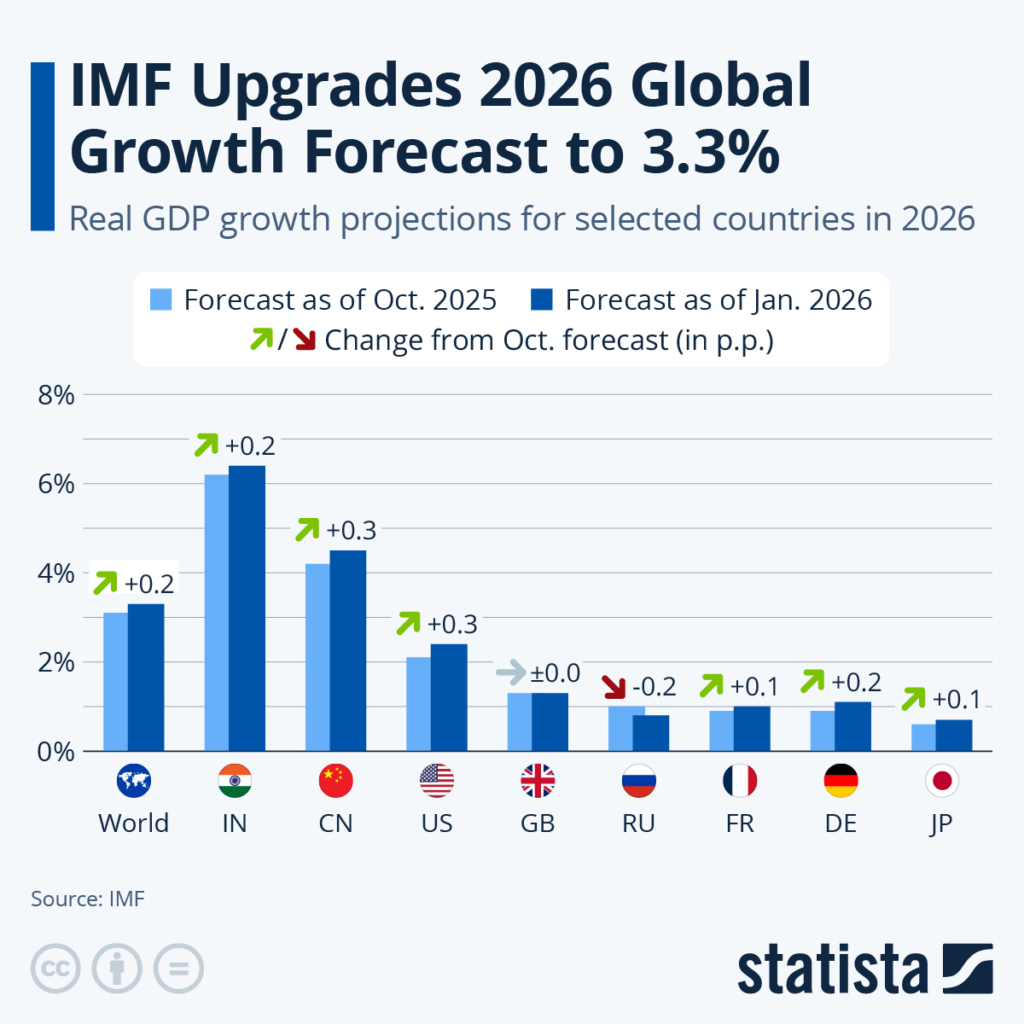
Figure 1 – 2026 Global Growth Forecast
As seen in Figure 1, most core indicators still look stable on the surface. Growth is positive, manufacturing is expanding, and unemployment hasn’t spiked.
But under the surface, things are shifting.
Consumer confidence has started to fall. Inflation risks are rising again due to oil prices. And one of the most reliable recession indicators, the Sahm Rule*, has reportedly been triggered.
That combination doesn’t guarantee a recession. But it does tell you one thing:
The system is becoming fragile.
- The Sahm Rule is a reliable economic indicator created by economist Claudia Sahm in 2019 that signals the start of a recession. It is triggered when the 3-month moving average of the national unemployment rate rises by 0.50 percentage points or more above its 12-month low, historically signaling a recession.
Why 2026 Feels Similar to Pre-Recession Environments
What’s making investors uneasy right now isn’t just the data, it’s the pattern.
Before most recessions, the economy doesn’t collapse overnight. It slows down gradually while risk builds in the background.
And we’re seeing similar dynamics now.
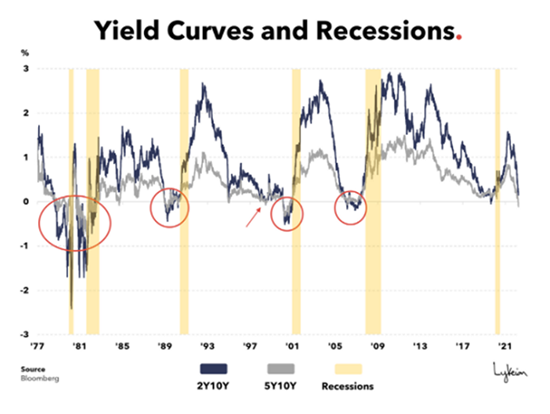
Figure 2 – Yield Curves and Recessions
As seen in Figure 2, several conditions today mirror past pre-recession setups:
- The yield curve was inverted for a long period and only recently normalized
- Energy prices are rising again
- Consumer confidence is weakening
- Growth is slowing, even if still positive
At the same time, there are key differences. Massive investment in AI is acting as a buffer, keeping parts of the economy strong.
That’s why the current environment isn’t collapsing.
A Divided Economy: Tech vs Energy
Right now, two forces are pulling the global economy in opposite directions.
On one side, you have the tech sector, driven by AI, still growing strongly. On the other, you have the energy sector pushing costs higher across the system.
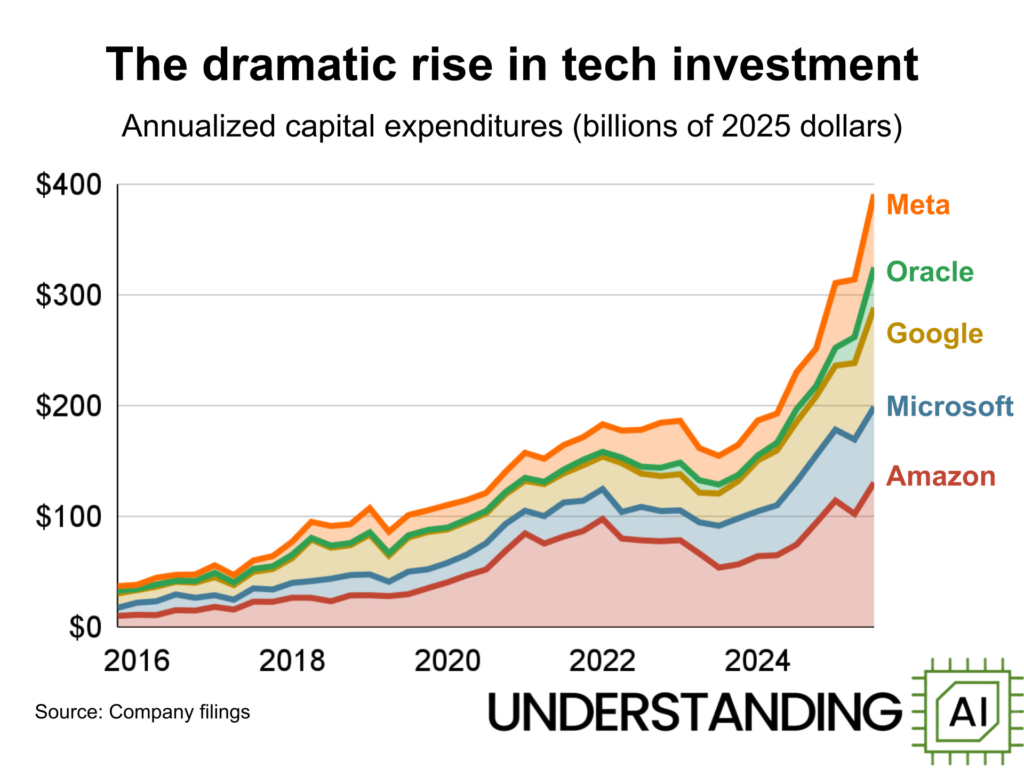
Figure 3 – Rise in Tech Investment
As seen in Figure 3, this creates a difficult balance.
AI investment is supporting growth, but high energy costs act like a tax on the rest of the economy. If oil continues rising, it can slow everything else down even if tech remains strong.
This is why central banks are stuck.
They can’t cut rates aggressively because inflation risks are still present. But they also can’t tighten too much without risking a slowdown.
Why This Time Feels Uncomfortable
What makes the current situation different is the combination of pressures hitting at once.
Energy prices are rising again, with oil hovering around or above $100 per barrel. That acts like a hidden tax on the global economy, increasing costs for businesses and consumers at the same time.
At the same time, central banks are stuck.
The Federal Reserve and ECB have paused interest rate changes, but not because everything is fine, but because they’re trying to avoid making things worse. Inflation hasn’t fully gone away, and cutting rates too early could reignite it.
This creates a difficult scenario often described as “fragile growth” where the economy is still expanding, but increasingly vulnerable.
A Warning Few People Are Talking About
One of the more overlooked risks right now comes from government finances themselves.
According to recent U.S. Treasury data, highlighted by Fortune:
“The U.S. government is insolvent… with $6.06 trillion in assets against $47.78 trillion in liabilities.”
That doesn’t mean collapse is imminent, but it highlights a structural issue: debt levels are extremely high, and the system depends on continued growth and liquidity to remain stable.
At the same time, some market analysts are already positioning defensively. A recent analysis cited by Seeking Alpha notes that:
“The bull market may be over,” pointing to slowing growth, weakening employment data, and economically sensitive stocks already declining.
This is how downturns typically begin, not with panic, but with subtle shifts in behavior and sentiment.
So What Happens to Crypto If a Recession Hits?
To understand that, you need to separate myth from reality.
Crypto is often described as “digital gold,” but in practice, it behaves more like a high-risk asset, especially in the early stages of economic stress.
You’ve already seen hints of this in recent weeks.
This tells you something important:
Crypto is already trading as part of the global macro system.
Phase 1: The Initial Sell-Off
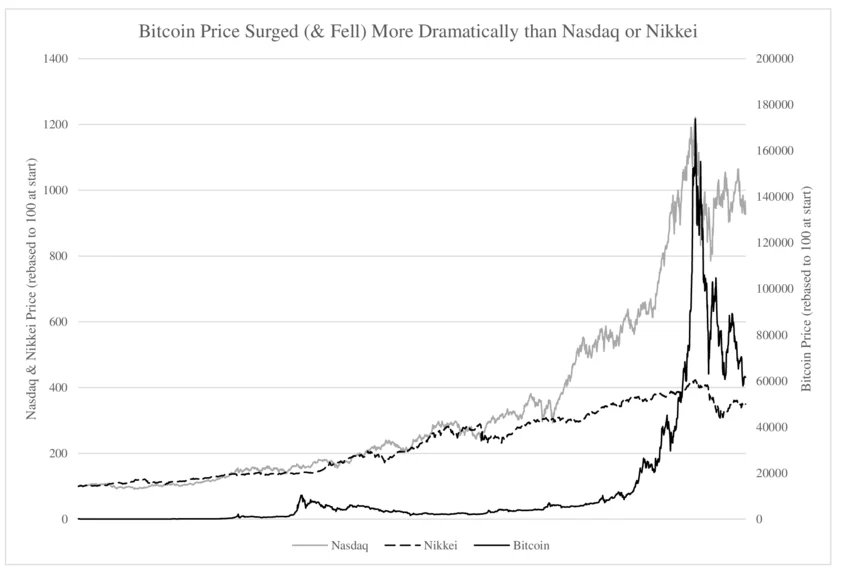
As seen in Figure 2, the first phase of a recession is usually aggressive.
When liquidity dries up, investors sell what they can and crypto is one of the easiest assets to sell quickly because it trades 24/7.
That’s why Bitcoin often drops alongside stocks, and sometimes even faster.
Phase 2: Bitcoin vs Altcoins
Not all crypto assets behave the same in a downturn.
Bitcoin tends to hold up better relative to the rest of the market, because it’s seen as the “core” asset. When fear increases, capital often rotates out of smaller altcoins and into Bitcoin or into stablecoins.
That’s why during periods of stress, Bitcoin dominance usually rises.
You can already see early signs of this dynamic in recent market structure shifts.
Phase 3: The Recovery (Where Opportunity Comes From)
Here’s the part most people miss.
Recessions also reset the markets, they don´t just destroy them.
Once economic conditions worsen, central banks typically respond by:
- Cutting interest rates
- Injecting liquidity into the system
- Stimulating growth
And historically, those actions have been one of the biggest drivers behind Bitcoin’s strongest bull runs.
In other words, the same crisis that causes the drop often creates the next opportunity.
Where We Are Right Now
We are not in a confirmed recession.
But we are also not in a stable environment.
The current setup sits somewhere in between:
- Growth is slowing
- Risk indicators are rising
- Macro uncertainty is increasing
Markets are starting to price in the possibility that things could get worse, but they’re not fully there yet.
Final Take
A global recession in 2026 is not guaranteed.
But the probability is no longer low.
And for crypto, that creates a very specific path:
- Short term → volatility and downside risk
- Medium term → market reset
- Long term → potential for a new cycle driven by liquidity
The key is understanding that crypto doesn’t operate outside the system.
It reacts to it often faster and more aggressively than anything else.
And right now, that system is starting to show signs of stress.
