

The cryptocurrency market is ending the week of March 13, 2026 with a cautiously bullish recovery, as Bitcoin and several major cryptocurrencies pushed higher despite ongoing geopolitical tensions and global market uncertainty.
While traditional markets struggled with rising oil prices and macroeconomic risks, crypto assets showed resilience and outperformed many global equities this week.
Bitcoin is now trading back in the $71,000–$72,000 range, while Ethereum delivered one of the strongest recoveries among major cryptocurrencies.
Major Crypto Performance This Week
Across the market, several major assets recorded gains.
Bitcoin (BTC)
Bitcoin climbed roughly 4.47% over the past week, reclaiming the $71,000–$72,000 range after briefly dropping below $65,000 during the early stages of geopolitical tensions.
Ethereum (ETH)
Ethereum recovered strongly and moved back above $2,100, benefiting partly from short covering as traders closed bearish positions.
XRP
XRP maintained stability around $1.40, continuing its gradual recovery alongside the broader market.
Solana (SOL)
Solana stabilized near $86, showing early signs of recovery after a difficult start to the year.
Chart: Weekly Performance of Major Crypto Assets
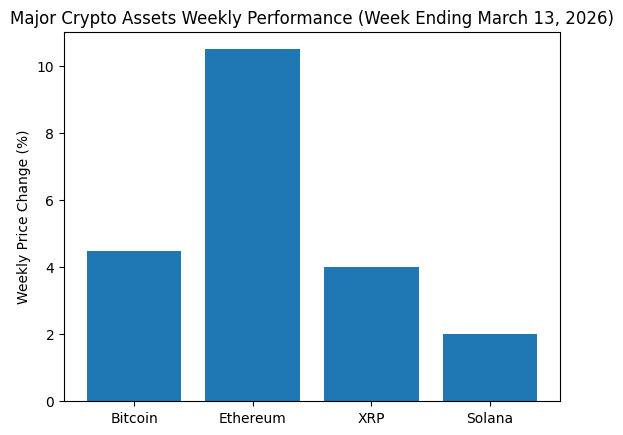
This chart shows how Ethereum led the weekly rally while Bitcoin and XRP also posted moderate gains.
Bitcoin’s Recovery Despite Global Market Stress
One of the most interesting developments this week is how Bitcoin held up while traditional markets struggled.
Global markets faced pressure due to the escalating US-Iran conflict, which triggered a surge in oil prices.
Brent crude oil climbed to roughly $101–$103 per barrel, driven by disruptions around the Strait of Hormuz, which handles about 21% of global oil supply.
Despite this major macro shock, Bitcoin quickly recovered after an initial drop to $63,000, suggesting growing resilience among crypto investors.
Chart: Bitcoin vs Oil Price Snapshot
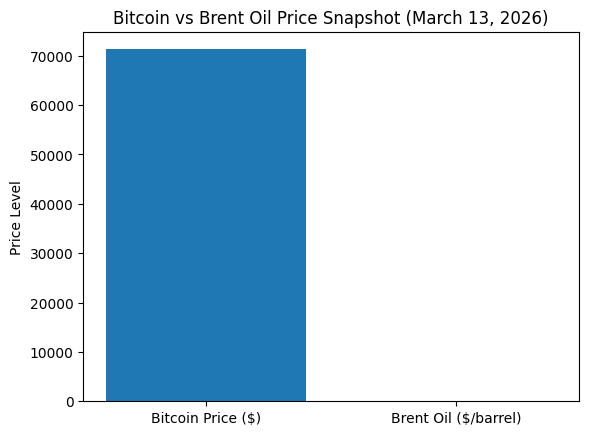
This comparison highlights how oil prices are reacting to physical supply shortages, while Bitcoin is responding more to investor sentiment and liquidity flows.
Why Crypto Is Acting Differently Than Other Markets
Part of the reason crypto recovered faster than traditional markets is the 24/7 nature of cryptocurrency trading.
When the geopolitical news first broke over the weekend, crypto markets immediately absorbed the shock, allowing prices to adjust quickly.
Traditional markets, which close on weekends, often experience delayed reactions when trading reopens.
Another factor is Bitcoin’s growing narrative as a geopolitical hedge.
In fact, some investors in regions affected by conflict are reportedly moving funds into crypto so they can transport wealth across borders without relying on traditional banking systems.
We explored this trend earlier in the week in our analysis of why crypto has been rising while stocks struggle:
https://dailycoinradar.com/why-crypto-is-rising-while-stocks-are-falling-march-2026/
Macroeconomic Data Helped Support Risk Assets
Economic data released on Friday also helped support crypto markets.
According to market data reported by MarketPulse:
https://www.marketpulse.com/markets/markets-weekly-outlook-financial-damage-of-war-fomc/
The Core Personal Consumption Expenditures (PCE) inflation report came in slightly softer than expected:
Core PCE:
2.8% vs 2.9% expected
Lower inflation reduces the pressure on the Federal Reserve to raise interest rates aggressively, which typically supports risk-on assets like cryptocurrencies.
Institutional Activity Continues to Influence Crypto
Institutional investors also remained active in the market.
Recent data showed:
- $53.8 million in Bitcoin ETF inflows
- $72.4 million in Ethereum ETF inflows
Large investment firms are continuing to build exposure to digital assets, even as market volatility remains elevated.
Earlier this week we also examined Bitcoin’s liquidity structure and institutional positioning:
https://dailycoinradar.com/bitcoin-liquidity-analysis-etf-flows-positioning-march-2026/
Major Network Milestone for Bitcoin
Another major milestone occurred this week.
On March 10, 2026, the 20 millionth Bitcoin was officially mined.
Because the Bitcoin protocol caps supply at 21 million coins, this means there is now only one million Bitcoin left to be mined over the next 120 years.
This increasing scarcity is one reason many investors continue to view Bitcoin as a long-term store of value.
Some analysts are even beginning to question whether Bitcoin could eventually function as a true safe-haven asset.
According to analysis cited by The Motley Fool, if that narrative strengthens, Bitcoin could potentially be undervalued near $70,000.
Polkadot Supply Shock: Why It Matters
Another important development this weekend is happening in the Polkadot (DOT) ecosystem.
The network is implementing a major issuance reduction, cutting the number of new tokens created each year from 120 million to 55 million.
For investors, this matters because it changes the token’s long-term supply dynamics.
Here is why the change is important:
1. A “Halving-Like” Effect
Fewer new tokens entering circulation means the existing supply becomes more valuable over time.
2. A Hard Supply Limit
For the first time, Polkadot will have a maximum token cap, making it more similar to scarce assets like Bitcoin.
3. Lower Inflation
Reduced issuance means the value of existing tokens is diluted more slowly.
However, there is also a short-term risk.
Because investors already anticipated this event, some traders may sell after the announcement to lock in profits, which could lead to temporary volatility this weekend.
The Bigger Macro Picture
One of the most interesting themes this week is the divergence between oil and crypto markets.
Oil prices are rising because of physical supply disruptions, while Bitcoin is moving more in response to global liquidity and investor sentiment.
This creates a unique dynamic where crypto can sometimes behave like a digital macro hedge rather than a purely speculative asset.
What Crypto Traders Are Watching Next Week
Looking ahead, several events could determine the next major move for the crypto market.
Federal Reserve Meeting (March 18–19)
Investors are closely watching the upcoming FOMC meeting, which will determine the future direction of interest rates.
Geopolitical Developments
Any escalation in the US-Iran conflict could push oil prices higher and increase global market volatility.
Bitcoin Resistance Levels
Bitcoin now faces key resistance near $75,000, which traders see as the next major breakout level.
The Bottom Line
The crypto market is finishing the week stronger than many expected, especially considering the global macro uncertainty.
Bitcoin’s ability to reclaim the $71K–$72K range, combined with strong Ethereum performance, suggests that investor confidence is gradually returning.
However, with geopolitical tensions and central bank decisions looming, the market could remain volatile in the coming days.
For now, crypto appears to be entering the weekend with cautious bullish momentum.
3 Comments
Pingback: Crypto Weekly Outlook: Bitcoin Holds $73K as FOMC Decision, ETF Inflows and Institutional Buying Shape the Week – Dailycoinradar
Pingback: XRP Overtakes BNB to Become 4th Largest Crypto as Price Breakout, ETF Inflows and Ripple Expansion Drive Rally – Dailycoinradar
Pingback: Crypto Liquidity, Market Positioning and ETF Flows (March 2026): Why Thin Liquidity Is Driving Volatility – Dailycoinradar