

The crypto world has long operated in a legal grey area, especially in Europe, where each country had its own patchwork of rules (or none at all). That changed when the Markets in Crypto-Assets (MiCA) regulation came into force. It’s the first law of its kind anywhere in the world at this scale, and if you own, trade, or use crypto in Europe, it affects you.
Here’s everything you need to know.
What Is MiCA?
MiCA stands for Markets in Crypto-Assets. It’s a law passed by the European Union that creates a single rulebook for crypto across all 27 EU member states. Before MiCA, a crypto exchange might be perfectly legal in Germany but operating in a murky legal grey zone in France. That inconsistency is now gone.
Think of MiCA as the EU saying: “We’re treating crypto like a real financial market with real rules.”
Why Does It Matter?
MiCA aims to create a harmonised regulatory framework for crypto-assets in the European Union, promote innovation, and foster crypto-asset use while ensuring financial stability of issuers and service providers. The regulation also addresses investor and consumer protection for the issuance, trading, and custody of crypto-assets, and seeks to prevent market abuse on cryptocurrency exchanges.
NatLawReview
MiCA matters for three groups of people:
- Everyday users and investors — you now have legal protections you didn’t have before.
- Crypto businesses — they must follow strict licensing rules or shut down in the EU.
- The broader economy — stablecoins, in particular, are now tightly controlled to prevent a collapse that could ripple through the financial system.
What Does MiCA Actually Cover?
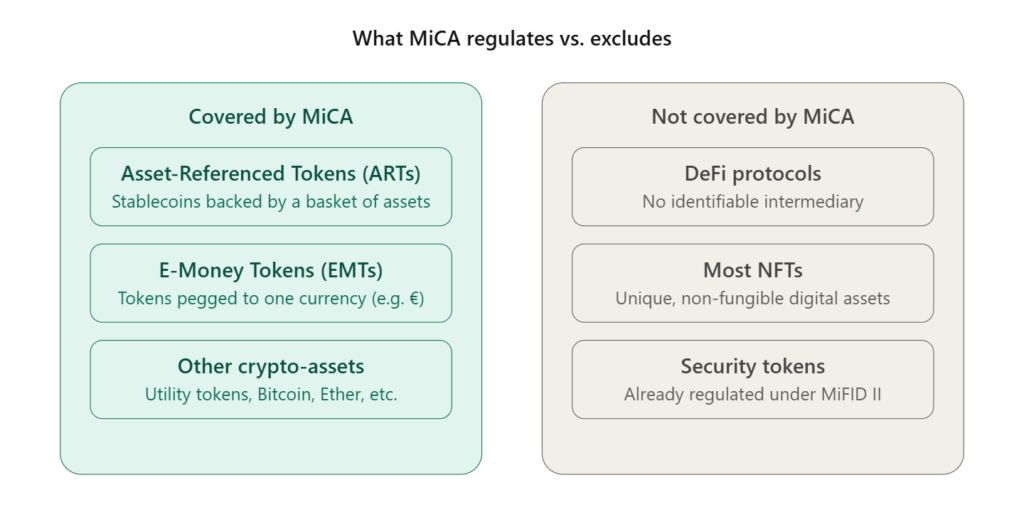
MiCA distinguishes between three types of crypto-assets:
- Asset-Referenced Tokens (ARTs), which maintain a stable value by referencing a basket of assets or currencies;
- E-Money Tokens (EMTs), which maintain a stable value by referencing a single official currency;
- And “other” crypto-assets, a catch-all category that includes utility tokens providing access to a specific good or service. Greenberg Traurig LLP
As for what’s left out: genuinely decentralised finance protocols with no identifiable intermediary are generally outside of MiCA’s scope, and most NFTs are excluded unless they are issued in large series or collections that make them effectively fungible. LegalNodes Assets already regulated as financial instruments under existing EU law (MiFID II) are also excluded.
What Are the Rules for Crypto Businesses?
Any company offering crypto services to EU customers such as exchanges, wallets, custodians, and brokers, is now classified as a Crypto-Asset Service Provider (CASP) and must follow strict rules:
1. Get licensed. CASPs must obtain authorisation from a national regulator in one EU country. Once licensed, they can operate across all 27 member states with a single “passport” no need to apply country by country.
2. Maintain a physical presence. A registered EU office, at least one EU-based director, and a real place where key decisions are made.
3. Meet minimum capital requirements:
- €50,000 for advisory or portfolio management
- €125,000 for executing orders
- €150,000 for running a trading platform or custody service
4. Publish a White Paper. Before issuing any token to the public, companies must publish a detailed document disclosing exactly what the project is, how it works, and what the risks are.
European Securities and Markets Authority
5. Keep your money separate from customers’ money. Client funds must be held apart from company assets at all times. Client fiat must be placed with an EU credit institution or a central bank by the end of the next business day, and never used for company operations.
AdamSmith
What About Stablecoins?
Stablecoins get special attention under MiCA, because a collapsing stablecoin could cause real economic damage. The key rules are:
- Issuers must hold 1-for-1 liquid reserves for every token in circulation, there must be an equivalent amount of real assets in reserve.
- Monthly audited reports are required to prove these reserves exist.
- Non-euro stablecoins used for payments are capped at €200 million per day to protect the euro’s dominance.
- Major exchanges have already delisted some stablecoins (like certain versions of Tether) that couldn’t prove compliance.
What Does MiCA Mean for You as a User?
This is where it gets personal. Here’s what changed for everyday crypto users:
You have a 14-day cooling-off period. For certain token purchases, you can change your mind and get a refund within two weeks just like buying a product online.
Your privacy looks different now. Under the Travel Rule, every transfer between crypto service providers must include personal identity data, sender and recipient regardless of the amount. Anonymity is essentially gone within the regulated system.
Hardware wallets come with new friction. If you transfer more than €1,000 to your own hardware wallet (like a Ledger or Trezor), the exchange must verify that you actually own that wallet.
Your taxes are being tracked automatically. Since January 2026, EU exchanges automatically report your transaction data to national tax authorities. Unreported crypto gains are now very hard to hide.
The Timeline: When Did All This Happen?
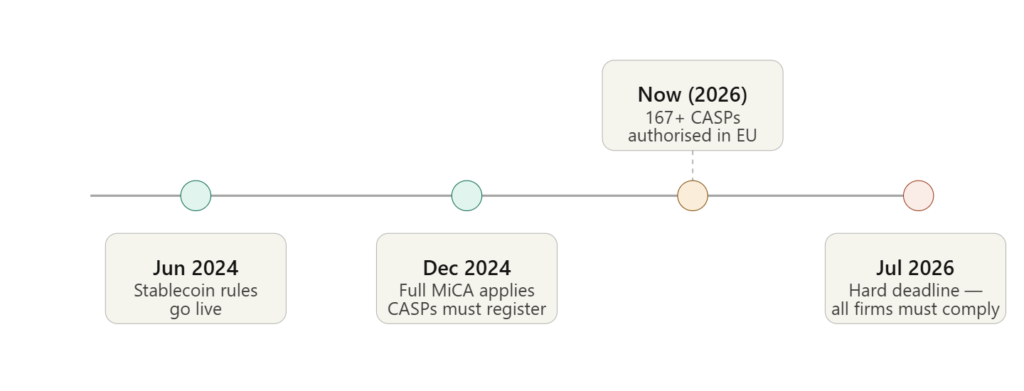
The July 1, 2026 deadline is the final cutoff. Any crypto firm that was operating under old national rules must either hold a full MiCA licence by that date, or stop offering services in the EU entirely.
What Happens If a Company Breaks the Rules?
MiCA has teeth. Breaches can lead to administrative sanctions at the national level, including fines, remedial orders, suspension or withdrawal of authorisation, public notices of infringements, and management bans.
Sb-sb
Fines for non-compliance can reach:
- Up to €5 million, or
- Between 3% and 12.5% of a company’s total annual turnover, whichever is higher.
Regulators have already started enforcement. France’s AMF, Germany’s BaFin, and others are actively reviewing firms and issuing authorisations.
Who’s Already Compliant?
As of March 2026, over 167 entities across 20 EU countries have been authorised under MiCA, including several major traditional banks that have moved into the crypto space. The Czech Republic, Netherlands, Malta and Germany are currently the most active hubs for new registrations.
Major platforms like Bybit EU and Bitpanda are headquartered in Vienna, Austria, and are operating fully under MiCA. Others have chosen to relocate outside the EU rather than bear the compliance costs, which are estimated at €500,000 to €1 million for smaller firms.
The Bottom Line
MiCA is the EU’s attempt to bring crypto into the mainstream financial system, with all the protections and oversight that implies. For users, it means more safety and transparency. For businesses, it means higher barriers to entry but access to 450 million potential customers with a single licence.
Whether you see it as a protective framework or overregulation, one thing is clear: the era of crypto operating outside the law in Europe is over.
1 Comment
Pingback: DeFi in 2026: Why It’s Quietly Strengthening While Crypto Markets Turn Defensive – Dailycoinradar