
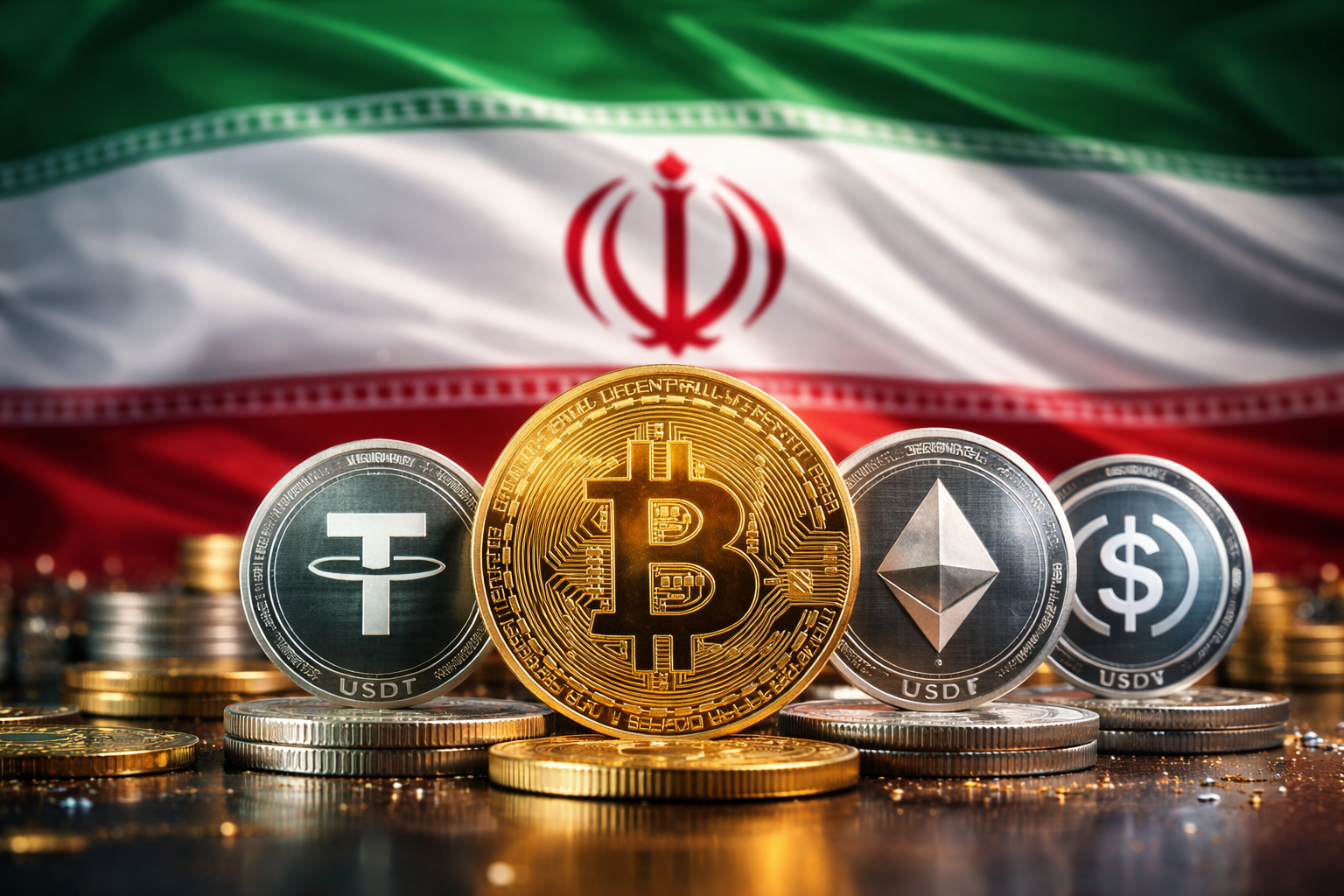
Cryptocurrency has become a critical, yet highly contested part of Iran’s financial system. Driven by international sanctions, runaway inflation, and domestic unrest, digital assets are now deeply embedded in both everyday survival for citizens and strategic operations by the state. However, this adoption exists under one of the world’s most restrictive and tightly controlled regulatory environments.
A Dual System: State Control vs. Public Necessity
In Iran, crypto operates in two parallel realities. On one side, the government uses digital assets as a tool to bypass sanctions. On the other, ordinary citizens rely on crypto as a hedge against economic collapse.
The Iranian rial has fallen to historic lows—around 1.4 million rials per U.S. dollar, down over 40% since mid-2025. This collapse has pushed millions of Iranians toward stablecoins, particularly Tether, to preserve purchasing power. Estimates suggest roughly 22% of the population now uses or owns cryptocurrency.
Sanctions Evasion and State Usage
Cryptocurrency plays a strategic role for the Iranian government and state-linked entities such as the Islamic Revolutionary Guard Corps. Digital assets are used to bypass international banking restrictions, fund imports, and settle transactions that would otherwise be blocked by sanctions.
In a striking example, Iran’s Ministry of Defence export arm has publicly indicated it accepts digital currencies for certain transactions, underscoring how crypto has become embedded in sanction-evasion infrastructure.
Heavy Regulation and Centralized Oversight
Despite widespread use, Iran maintains strict regulatory control. The Central Bank of Iran holds exclusive authority over the crypto market. In early 2025, it ordered the shutdown of rial payment gateways for exchanges, later reopening them only under strict licensing, AML/KYC compliance, and full data-sharing requirements.
Crypto payments for domestic transactions remain strictly banned, ensuring the rial retains dominance in the local economy. Advertising crypto is also prohibited across Iranian media.
Mining: Legal, but Pushed Underground
Crypto mining is technically legal but heavily constrained. Licensed miners face high energy tariffs and are required to sell mined assets directly to the central bank. These restrictions have pushed many miners underground, exacerbating strain on Iran’s power grid and contributing to frequent blackouts.
Despite these challenges, Iran is still estimated to account for 2–4% of global Bitcoin hashrate, a meaningful share that highlights the country’s role in global mining despite internal instability.
Protests, Blackouts, and Decentralization
Ongoing protests tied to inflation and currency collapse have accelerated crypto adoption. Internet shutdowns imposed during unrest have unintentionally highlighted the value of decentralized systems. Some users have turned to alternative connectivity solutions such as Starlink and Blockstream’s satellite network to access wallets and blockchain data.
A major setback occurred in June 2025, when Iran’s largest exchange, Nobitex, suffered a high-profile hack. The incident severely damaged public trust and triggered capital flight to offshore platforms.
Global Impact: Limited but Not Irrelevant
Despite Iran’s internal turmoil, the global crypto market has seen minimal direct impact. Bitcoin’s network security and price action remain driven primarily by macroeconomic forces such as U.S. interest rates and employment data, not Iranian protests.
That said, Iran’s situation contributes to broader geopolitical risk sentiment. Periodic “risk-off” reactions can cause short-lived volatility, but the crypto market has largely absorbed these shocks without structural disruption.
The Road Ahead
Iran is also developing a state-controlled CBDC, the so-called “Rial Currency,” aiming to leverage blockchain technology while maintaining full monetary oversight. This move signals a future where decentralized crypto and centralized digital money coexist in tension.
Final Takeaway
Crypto in Iran is no longer speculative—it is systemic. For citizens, it is a financial lifeline. For the state, it is a geopolitical tool. While its global impact remains contained, Iran represents one of the clearest real-world examples of how cryptocurrency functions under extreme economic and political pressure.