
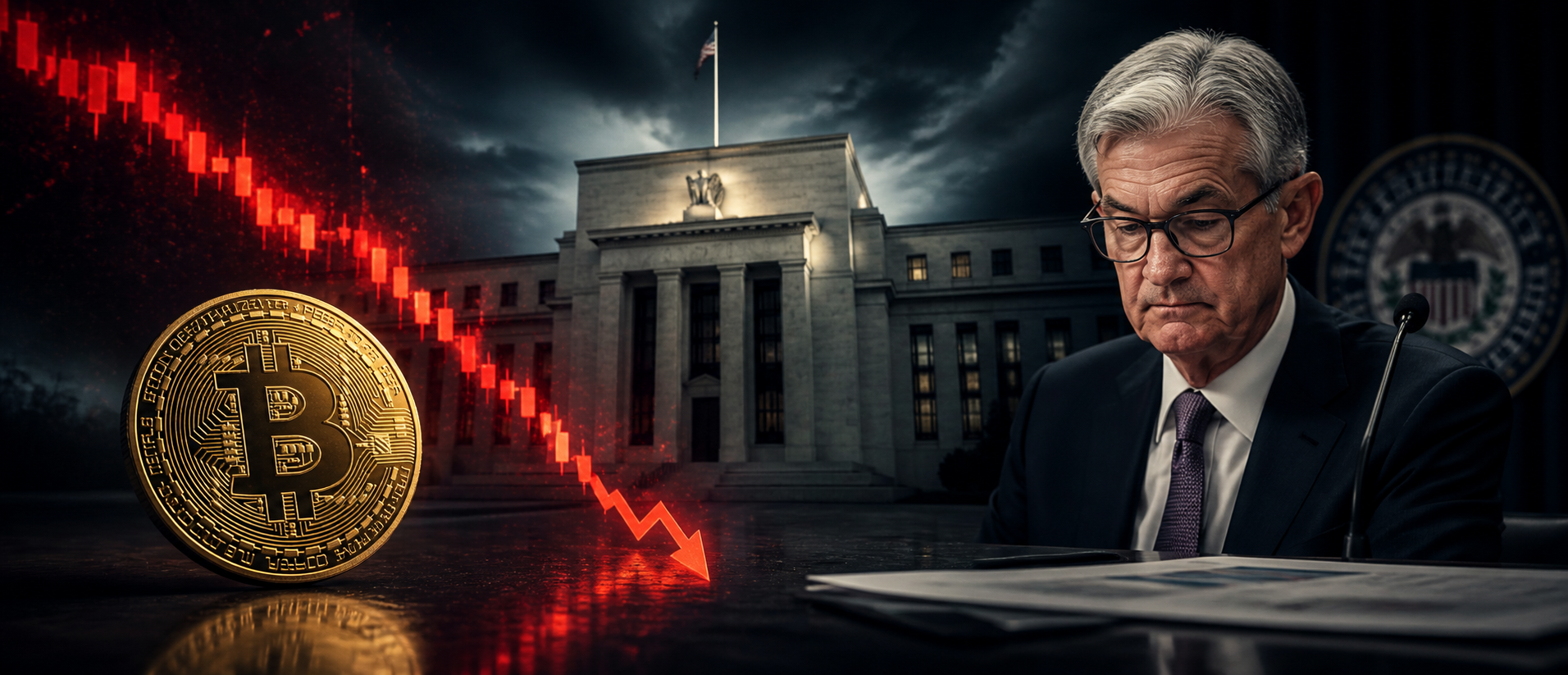

Bitcoin entered the week of April 28 looking like it had finally turned a corner. A 21% rally from its early-April low near $65,000, record ETF inflows, and a ceasefire in Iran had traders talking about $100K. Then the $80,000 wall hit twice, and Jerome Powell’s final FOMC press conference did what the Fed has done to Bitcoin eight of the last nine times. By Wednesday April 30, BTC had tagged an intraday low of $74,937. The setup, the catalyst, and the next levels are all in the data.
The $80,000 Rejection: What the Charts Actually Say
Bitcoin twice failed to break above the $80,000 level of resistance over the past week, with the most recent attempt occurring during Asian hours on Monday. The decline comes after the largest cryptocurrency lost around 0.75% since midnight UTC on Tuesday, with several key price indicators flipping bearish, including the Coinbase Premium index. Tangem
Bitcoin entered the most important 24-hour window of April 2026 trading near $76,826, pinned under a key supply zone at $78,200–$79,200, with $100,000 as the ultimate psychological ceiling. A confirmed 4H close above $79,200 on strong volume would be the technical signal for a $100K attempt, with analyst Aksel Kibar identifying $106,852 as the breakout target on a sustained move above the descending channel. Ainvest
That breakout never came. Bitcoin touched $79,000 on April 27 as the Bitcoin 2026 Conference opened at The Venetian in Las Vegas, extending a four-week rally fueled by record ETF inflows and Strategy’s $2.54 billion BTC purchase on April 20. By April 28, the price had already slipped back to roughly $76,300. Crypto Briefing
The derivatives market had been warning anyone paying attention. According to Glassnode’s analysis, Bitcoin traders were boosting their negative leverage just before Powell’s speech, with open interest rising since yesterday’s $79K retest, funding predominantly below neutral, and spot and futures cumulative volume differential diverging with futures driving selling pressure. CoinPedia
📌 Related: Bitcoin’s Most Loaded Week of 2026: FOMC, Powell’s Farewell & Ceasefire Expiry
Powell’s Final FOMC: The Hawkish Goodbye That Moved Markets
The Federal Reserve held rates at 3.50%–3.75% on April 29, marking the third consecutive pause in 2026. This outcome was fully expected, with the CME FedWatch tool pricing in a near 100% probability of no change for weeks.
What made this meeting different wasn’t the decision itself, but the context around it. This was Jerome Powell’s final meeting as Fed Chair, with his term ending on May 15. Kevin Warsh is set to take over, and the press conference was effectively Powell’s last chance to shape the narrative before handing control to a successor who has openly criticized his policy approach.
Powell didn’t take a neutral tone. He emphasized that the Fed is facing an unusually complex environment, driven by four major supply shocks in rapid succession: the pandemic, the Ukraine war, global tariffs, and now the Iran conflict. Each of these has the potential to push both inflation and unemployment higher at the same time, creating a difficult balancing act for policy.
Markets reacted quickly to his comments. Expectations for rate cuts in 2026 dropped sharply to just 1%, down from around 25% the week before. The message was clear: the Fed is not ready to ease.
A major part of this problem is energy. Brent crude averaged around $103 per barrel in March, and the EIA expects prices to peak near $115 in the second quarter before easing below $90 later in the year. Powell made it clear that this type of inflation, driven by external energy shocks, is largely outside the Fed’s control.
Following the meeting and Powell’s final press conference, Bitcoin dipped to an intraday low of $74,937. This brought price just below the 20-day simple moving average at $75,664, a level many traders were watching closely as a potential support-resistance flip.
By late April, Bitcoin was trading near $75,900, still below the $78,000–$80,000 supply zone. This area remains important, as it aligns with both the True Market Mean and the short-term holder cost basis.
On the downside, key support sits between $65,000 and $70,000, with the $68,000 region acting as the first meaningful structural floor.
📌 Related: CLARITY Act Crypto: What the Senate Vote Means for Bitcoin, ETFs & the $5T Institutional Unlock European Business Magazine + 4
The 8-of-9 Pattern: Sell-the-News Is Working Again
This is not a random dip. It is a pattern with a 89% historical hit rate. BTC has dropped within 48 hours of 8 of the last 9 FOMC rate decisions. Cuts, holds, hawkish statements, dovish pivots but none of it mattered. The sell-the-news pattern has been the most reliable short-term signal in crypto since mid-2025.
Bitcoin conferences have marked local tops in five of the last six events dating back to 2019. The FOMC meeting on April 28-29 landed directly on top of the Bitcoin 2026 Conference, compressing two sell-the-news catalysts into one week for the first time in history. BTC typically drops 3–7% in the 48 hours after the Fed statement, then forms a tradeable bottom within 48–72 hours as selling pressure exhausts. Changelly
The one FOMC meeting in the 8-of-9 pattern where BTC did not sell off was May 2025, when the market entered the meeting already beaten down with a Fear and Greed index below 30. The April 2026 setup is not that, BTC entered this meeting on a 21% rally with improving sentiment. That looks more like the pre-FOMC euphoria setups that produced the worst post-meeting drops. Crypto Briefing
The confirmation signal going into May 1 is clear: watch ETF flow data. Net inflows or flat flows mean the institutional unwind is contained. Heavy outflows mean the selloff has legs beyond the normal 48-hour FOMC window. Changelly
ETF Flows: From $2.4B Inflows to BlackRock Pulling Out
The ETF story this week is a sharp reversal after one of the best streaks of 2026. Bitcoin spot ETFs logged their strongest performance of 2026, with eight consecutive days of inflows through April 23, totalling $2.43 billion for the month, that is nearly double March’s $1.32 billion. BlackRock’s iShares Bitcoin Trust (IBIT) has been the primary driver, adding over $3 billion year-to-date and surpassing 806,700 BTC in holdings, about 3.8% of Bitcoin’s total supply.
Then the tap turned off. After registering net cash inflows of over $2.11 billion between April 14 and 24, US spot Bitcoin ETFs reported a net cash outflow of roughly $352.86 million on April 27 and 28. BlackRock’s IBIT reported a net cash outflow of $112.25 million on April 28 alone, ending its 13-day streak of inflows. Decrypt
BlackRock’s IBIT held more than 812,276 BTC valued at roughly $62 billion, underscoring its influence on overall Bitcoin ETF sentiment. Combined US spot Bitcoin ETF flows showed a $352.86 million pullback across April 27 and 28, signaling a clear pause in institutional accumulation after a strong multi-week run. CoinLore
Critically, this is not a structural exit. Bitcoin’s options-to-futures open interest ratio dropped to 57.5%, the lowest since January 31, that suggests a sign of renewed bias for directional bets and higher short-term volatility. Persistently negative funding rates stem from institutional hedging and not outright bearish bets. The institutions are not leaving. They are pausing and repositioning ahead of a binary event they could not predict. CoinpediaTangem
📌 Related: Crypto Weekly Recap April 21–25: KelpDAO Hack, ETF Inflows & Bitcoin Tests $79K
The Bear Case: Michael Terpin and the $57K Target
Not everyone sees the current zone as accumulation. Michael Terpin, often called the “Crypto Godfather” for his involvement in the industry since 2013, argues that Bitcoin has not yet bottomed and predicts a low near $57,000 sometime in October, with no new all-time high likely this year. “Before a bull market for Bitcoin can be called, the price needs to break back above $100,000 and no support anywhere near has manifested,” Terpin said, adding: “Despite a double-digit gain thus far in April, we are very much still in a bitcoin fall.”
Terpin’s bear case has a structural logic: in an interview, Terpin described how during Asian trading hours on Monday, “the psychological barrier of $80,000 was strongly rejected, with the high price of oil a factor,” explaining this is typical at this stage of the Bitcoin cycle, with lower highs being rejected until the final capitulation. CCN
The counterargument is the ETF bid. Over the past week, US spot BTC ETFs absorbed $933 million, with BlackRock as the dominant buyer. This level of consistent institutional demand creates a structural price floor. Large allocators are buying on both red and green days, a fundamentally different dynamic than the 2022 bear market when institutions were absent. CCN
What Comes Next: Kevin Warsh, May, and the Road to $100K
The March dot plot showed a median expectation of one 25 basis point cut in 2026, but seven committee members projected zero cuts. With Warsh’s hawkish lean replacing Powell’s cautious approach, the probability of a 2026 cut has decreased. Markets should watch the June SEP for the first Warsh-influenced dot plot that is his first press conference, first dot plot influence, and first public articulation of his inflation framework will set the tone for the next four years of monetary policy.
Bitcoin has rallied nearly 15% over the past month, while the overall cryptocurrency industry has added about $400 billion in value since February. “The sellers who were spooked by macro shifts or quantum fears have already exited,” said Split Research founder Zaheer Ebtikar. “Bitcoin has found a stable floor and moved away from headline-driven drama and toward a more mature phase of growth.” European Business Magazine
The oil variable remains the wildcard. Crypto investors remain cautious as negotiations between the US and Iran have stalled and the Strait of Hormuz remains closed, with Brent Crude back above $104 a barrel, keeping inflation concerns front and center for the Federal Reserve. CoinDesk
The bull case rests on three triggers arriving in sequence: oil following the EIA’s path lower through Q2, Warsh’s June meeting not producing a hawkish shock, and the CLARITY Act Senate markup unlocking institutional capital more broadly into crypto. If those three align, the $79,200 supply zone breaks, and the next stop after that is $100,000. Bitcoin Foundation
Conclusion
Bitcoin’s April 28 story is a masterclass in how a perfect setup can still get the timing wrong. The fundamentals of ETF inflows, corporate accumulation, post-halving supply, regulatory progress, have never been stronger structurally. But $80,000 proved an immovable wall, FOMC delivered its sell-the-news dip for the eighth time in nine meetings, and Powell’s farewell added hawkish fuel that cut 2026 rate-cut odds from 25% to 1% in a single press conference. The $74,937 low matters less than what happens next: ETF flows on April 30 and May 1 are the immediate read, Warsh’s June meeting is the medium-term catalyst, and the $73,000–$76,800 support zone is the structural line that separates a controlled pullback from a deeper test of $68,000. For long-term holders, this is noise. For traders, the next 72 hours are everything.

2 Comments
Pingback: Bitcoin Breaks $80,000: Three-Month High Fuelled by Iran De-Escalation, Short Squeeze, and Returning ETF Demand - Dailycoinradar
Pingback: Bitcoin ETF Flows May 2026: The Institutional Demand Story Behind $82K - Dailycoinradar