


The global stablecoin market has just reached a new all-time high of about $314 billion, marking another major milestone for the crypto industry.
Stablecoins are essentially digital versions of traditional currencies like the U.S. dollar, designed to stay stable in price. They play a critical role in crypto because they act as the main liquidity source used to trade Bitcoin, Ethereum, and other cryptocurrencies.
After growing steadily since the end of 2023, the stablecoin market is now larger than ever, with Tether (USDT) and USD Coin (USDC) leading the way.
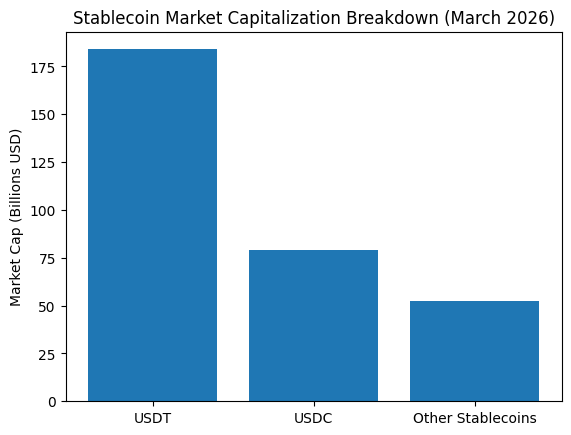
USDT Remains the Largest Stablecoin
At the top of the market is Tether (USDT).
- Market Cap: $183.9 billion
- Market Share: Around 60% of the entire stablecoin market
USDT is widely used across global crypto exchanges and is especially popular in retail trading and emerging markets.
Many traders use USDT as a digital dollar substitute to quickly move funds between exchanges or buy cryptocurrencies.
However, USDT is facing some regulatory pressure in Europe because it currently does not fully comply with new MiCA regulations.
USDC Is Becoming the Institutional Favorite
The second-largest stablecoin is USD Coin (USDC) with a market cap of $78.8 billion.
USDC has seen strong growth recently, expanding about 72% year-over-year.
What makes USDC different is its focus on regulatory compliance and partnerships with traditional financial institutions.
According to industry analysis cited by Forbes, USDC now represents roughly 70% of stablecoin transfer volume, meaning it is widely used for large payments and financial settlements.
https://www.forbes.com/sites/boazsobrado/2026/03/12/usdt-usdc-usd1-the-stablecoin-market-share-war/
Major companies like Visa, Mastercard, and Stripe are already using USDC to process 24/7 international payments and business transactions.
Why USDT Still Has the Largest Market Cap
Even though USDC is becoming the preferred stablecoin for institutions, USDT still dominates the market in total supply. The difference largely comes down to who is using each token and how they are used.
USDT became the default stablecoin on many crypto exchanges years before USDC gained traction. As a result, it built a massive user base among retail traders, offshore exchanges, and emerging markets. In regions where access to traditional banking or U.S. dollars is limited, USDT often acts as a digital substitute for the dollar, used for trading, remittances, and everyday transactions.
Another key factor is trading liquidity. Many crypto trading pairs are still quoted in USDT rather than USDC, meaning traders naturally hold and circulate USDT more frequently when moving between assets like Bitcoin, Ethereum, or altcoins. This constant trading activity helps keep a large amount of USDT in circulation.
USDC, on the other hand, is gaining momentum primarily through regulated financial infrastructure. Banks, payment networks, and fintech companies tend to favor USDC because of its regulatory compliance and transparency, which makes it easier to integrate into traditional financial systems.
In simple terms, USDT dominates retail and global trading markets, while USDC is becoming the stablecoin of choice for institutions and regulated finance. Both are growing, but they are expanding in different parts of the digital dollar economy.
New Stablecoins Are Also Entering the Market
While USDT and USDC dominate, several newer stablecoins are gaining attention.
Some examples include:
USD1 (World Liberty Financial)
- Market cap around $4.65 billion
Ethena (USDe)
- Over $6 billion market cap
- Designed as a yield-generating synthetic dollar
PayPal USD (PYUSD)
- Market cap above $4.1 billion
- Integrated with Solana for fast consumer payments
These projects are trying to compete by offering special features like yield or payment integrations.
Stablecoins Are Now Used for Much More Than Trading
Originally, stablecoins were mainly used to trade cryptocurrencies.
But today they are becoming part of the global financial system.
For example:
- Companies are using stablecoins for international payroll
- Businesses are settling payments 24/7 without banks
- Developers are building DeFi savings products using stablecoins
Because they move instantly and operate around the clock, stablecoins are starting to act as a new type of digital payment network.
Blockchains Are Competing for Stablecoin Activity
Different blockchain networks are now competing to host stablecoin transactions.
One surprising development is that TRON now holds more USDT than Ethereum, with about $85.3 billion in supply.
TRON became popular because it offers:
- Very low transaction fees
- Fast transfers
- Strong adoption in emerging markets
Meanwhile, other blockchains are also growing quickly.
For example, Aptos saw a massive 1,310% increase in retail stablecoin transactions, showing that new networks are starting to attract activity.
Regulation Is Starting to Reshape the Market
Governments are now creating clearer rules for stablecoins.
In the United States, regulators are working on implementing the GENIUS Act, which aims to create a legal framework for stablecoin issuers.
According to legal analysis of the proposal, the rules would require:
- Stablecoins to hold fully backed reserves
- Issuers to obtain regulatory licenses
- Strict oversight from financial authorities
https://www.lw.com/en/insights/occ-issues-proposal-to-implement-the-genius-act
In Europe, the MiCA regulation is already taking effect and requires stablecoins to hold 100% liquid reserves in regulated institutions.
These rules are expected to strengthen trust in the stablecoin market but may also reduce the number of smaller issuers.
Interest Rates Also Affect Stablecoins
Another factor many people overlook is U.S. interest rates.
Most stablecoin companies keep their reserves in short-term U.S. Treasury bonds, which earn interest.
When interest rates are high, issuers can generate huge profits from these reserves.
But if the Federal Reserve begins cutting rates later this year, that income could drop significantly.
This is one reason why some companies are now experimenting with yield-generating stablecoins, which pass returns back to users.
Stablecoins Are Becoming a Major Force in Finance
Stablecoin issuers have grown so large that they are now major buyers of U.S. government debt.
In fact, stablecoin companies collectively hold billions of dollars in U.S. Treasury bills, making them important players in global financial markets.
Because of this, stablecoins are sometimes described as acting like a “shadow banking system” within crypto.
What Does the Growth of Stablecoins Mean for Crypto?
The rapid growth of stablecoins is changing how the crypto market works. Instead of being purely speculative, the ecosystem is gradually turning into a financial infrastructure built around digital dollars.
As of March 2026, the stablecoin market is worth more than $314 billion, representing roughly 7%–15% of the total cryptocurrency market, according to industry estimates.
This growth has several important effects on the broader crypto economy.
Stablecoins Are Strengthening Market Liquidity
One of the most important roles stablecoins play is providing liquidity to crypto markets.
When traders want to exit volatile assets like Bitcoin or altcoins, they often move funds into stablecoins instead of withdrawing money to a bank. This allows them to stay inside the crypto ecosystem while avoiding market swings.
Because of this, stablecoins act as a kind of “safe parking space” for capital during volatile periods.
Today, stablecoins are also the dominant trading pair across most crypto exchanges, accounting for 80% to 90% of trading volume across both centralized and decentralized platforms.
In other words, stablecoins have largely replaced traditional fiat-to-crypto trading pairs.
Stablecoins Are Powering DeFi
Stablecoins have also become the core infrastructure of decentralized finance (DeFi).
Instead of simply acting as trading tools, they now power a wide range of financial services including:
- lending and borrowing
- decentralized exchanges
- yield-generating savings strategies
Many DeFi protocols rely on stablecoins as their base unit of value, similar to how the U.S. dollar functions in traditional finance.
New blockchain networks are also competing to become stablecoin transaction hubs, with chains like TRON and Solana offering extremely low transfer fees that make high-frequency transactions practical.
To know more about DeFi click here:
https://dailycoinradar.com/what-is-defi/
Stablecoins Are Connecting Crypto to Traditional Finance
Another major shift is that stablecoins are increasingly being used by traditional financial companies.
Major payment networks like Visa, Mastercard, and Stripe are now integrating stablecoins into their infrastructure for global business payments and settlement.
This is pushing stablecoins beyond the crypto market and into what some analysts describe as “the internet’s dollar.”
At the same time, regulatory frameworks such as the GENIUS Act in the United States and MiCA in Europe are creating clearer rules for stablecoin issuers, which could encourage more banks and financial institutions to enter the space.
Stablecoins Are Linking Crypto to the Global Economy
Stablecoin issuers have also become major buyers of U.S. Treasury bonds, which are used to back their tokens.
This means the crypto market is becoming increasingly connected to the traditional financial system and global debt markets.
At the same time, the rise of tokenized real-world assets (RWAs) is strengthening this link, as stablecoins are often used as the settlement currency for these digital assets.
The Bigger Picture
The rapid growth of stablecoins signals that crypto is evolving beyond speculative trading.
Instead, the industry is gradually building a digital financial system where stablecoins act as the core unit of value, similar to how the U.S. dollar functions in traditional markets.
For the broader crypto ecosystem, this expanding pool of stablecoin liquidity could eventually become one of the strongest drivers of future market growth.
What to Watch Next
Several key events could influence the stablecoin market in the coming months:
- Final rules for the GENIUS Act in the U.S.
- Full enforcement of MiCA regulations in Europe
- The Federal Reserve’s interest rate decisions
- Continued growth of yield-bearing synthetic stablecoins
If current growth continues, analysts believe the stablecoin market could soon move toward $350 billion in total value, further strengthening its role as the backbone of the crypto economy.

4 Comments
Pingback: Crypto Liquidity, Market Positioning and ETF Flows (March 2026): Why Thin Liquidity Is Driving Volatility – Dailycoinradar
Pingback: Institutional Adoption and Tokenization: Crypto’s Shift Toward Real-World Finance – Dailycoinradar
Pingback: What Is a Stablecoin? The Complete Guide - Dailycoinradar
Pingback: Crypto Weekly Outlook: Bitcoin Holds $73K as FOMC Decision, ETF Inflows and Institutional Buying Shape the Week - Dailycoinradar